Why visit
Kazakhstan is the world's largest landlocked country: the Charyn Canyon, Big Almaty Lake, singing dunes in Altyn-Emel, and Almaty's leafy, mountain-backed boulevards. Winter adds cheap, empty skiing at Shymbulak.
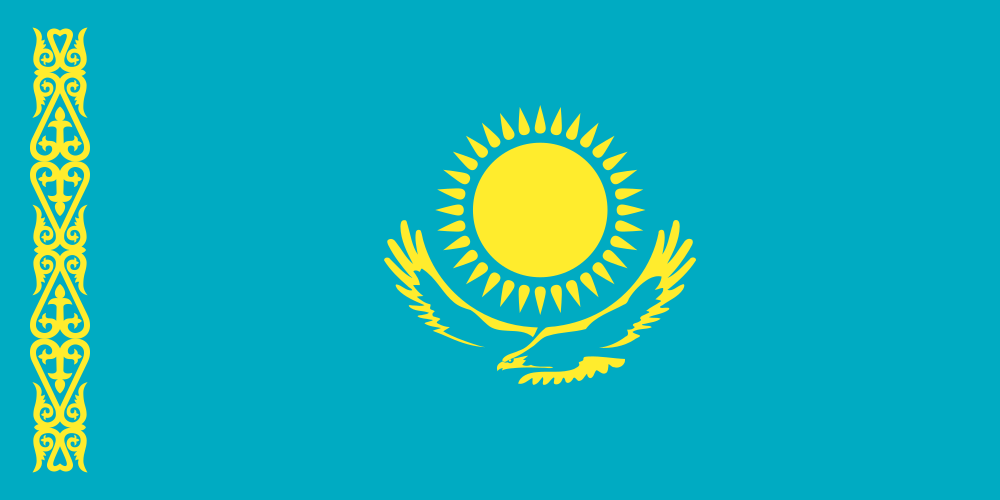
Country - Asia
Why visit
Kazakhstan is the world's largest landlocked country: the Charyn Canyon, Big Almaty Lake, singing dunes in Altyn-Emel, and Almaty's leafy, mountain-backed boulevards. Winter adds cheap, empty skiing at Shymbulak.
How to use this result
Kazakhstan works best as a first-pass travel idea. Start with the region, season, and themes on this page, then compare flights, entry rules, safety guidance, and local transport before treating it as a real option.
Use Astana as the administrative starting point, then check whether the strongest trip idea is actually the capital, a coastal area, a nature route, or another city in Kazakhstan.
At a glance
Location
48.0°, 68.0°
Coast
Landlocked
Traffic
Drives on the right
Time zones
Spans 2 time zones
Country area
2,724,900 km²
1,052,089 mi²
Country population
19.8 million
7/km²
Subregion
Central Asia
Currency
Kazakhstani tenge (₸)
KZT
Dial
+76
Languages
Kazakh, Russian
Demonym
Kazakhstani
Internet
.kz
UN
Member state
ISO code
KZ / KAZ
Where in the world
48.0° - 68.0°
Click the map to open in Google Maps. Outline via svg-maps/world - CC BY 4.0
Did you know
Bordering Kazakhstan
Traveler notes
Plan checks
Explore more
Facts last reviewed June 2026 against GeoNames and national statistics sources. See the editorial policy for how destination data is maintained.
Frequently asked about Kazakhstan
Astana is the capital of Kazakhstan.
Kazakhstan uses the Kazakhstani tenge (₸), ISO code KZT.
The primary languages are Kazakh and Russian.
Yes, Kazakhstan is landlocked: it has no sea coastline.
Kazakhstan borders China, Kyrgyzstan, Russia, Turkmenistan, Uzbekistan.
The calling code is +76.
May–Sep. Check current weather and local events before booking.
Other Asia destinations
Yemen
Yemen's Socotra island is an evolutionary island of dragon's blood trees found nowhere else, reached by limited charter flights. The mainland, with Sana'a's gingerbread towers and Shibam's mud skyscrapers, remains closed by war.

Istanbul
Istanbul straddles two continents. Hagia Sophia, Blue Mosque, Topkapi Palace, the Grand Bazaar (4,000 shops), Bosphorus ferries, and Karaköy's new food scene.
Cappadocia
Cappadocia is volcanic fairy-chimney valleys carved by 3,000 years of troglodyte dwellers. Hot-air balloons at dawn, underground cities, cave hotels.

Kyoto
Kyoto is 1,600 Buddhist temples, 400 Shinto shrines, Arashiyama bamboo, Gion's geisha district, and a food culture that defined Japanese cuisine.
Osaka
Osaka is Japan's food capital. Takoyaki, okonomiyaki, kushikatsu. And Dotonbori's neon at night. Plus Osaka Castle and an easy day-trip to Nara.
Hiroshima
Hiroshima is the Peace Memorial Park and Genbaku Dome, a rebuilt city with okonomiyaki variants, and the torii-in-water at Miyajima's Itsukushima Shrine.