Why visit
Warsaw was 85% destroyed in WWII and meticulously rebuilt. The Old Town is a UNESCO resurrection. Jewish history, Chopin museums, and a booming restaurant scene add modern layers.

Why visit
Warsaw was 85% destroyed in WWII and meticulously rebuilt. The Old Town is a UNESCO resurrection. Jewish history, Chopin museums, and a booming restaurant scene add modern layers.
Country
Region
Europe
How to use this result
Warsaw is useful when you want a city-level starting point in Poland. Check whether the capital is the best arrival city, a practical transfer point, or mainly a geography and planning reference.
Before planning around Warsaw, compare airport access, local transport, time zone, neighborhood choices, weather, safety guidance, and whether another city in Poland better matches the trip style.
Warsaw at a glance
City population
1.9 million
Metro: 3.1 million
Elevation
100 m
328 ft
Time zone
UTC+1 (UTC+2 DST)
Europe/Warsaw
Airport
WAW
Warsaw Chopin
Founded
13th century
Getting around
Metro (2 lines), trams, buses, Veturilo bikeshare
Signature dish
Pierogi, żurek, bigos, schabowy, pączki
Neighborhoods for travelers
Poland at a glance
Country center
52.0°, 20.0°
Coast
Has coastline
Traffic
Drives on the right
Time zones
Single time zone
Country area
312,679 km²
120,726 mi²
Country population
38.3 million
122/km²
Subregion
Central Europe
Currency
Polish złoty (zł)
PLN
Dial
+48
Language
Polish
Demonym
Polish
Internet
.pl
UN
Member state
ISO code
PL / POL
Where in the world
52.0° - 20.0°
Click the map to open in Google Maps. Outline via svg-maps/world - CC BY 4.0
Did you know
Bordering Poland
Traveler notes
Plan checks
Explore more
Facts last reviewed June 2026 against GeoNames and national statistics sources. See the editorial policy for how destination data is maintained.
Frequently asked about Warsaw
Warsaw is the capital city of Poland. It has a population of about 1.9 million. The city sits at 100 m above sea level.
Warsaw uses the Polish złoty (zł), ISO code PLN.
The primary language is Polish.
The calling code is +48.
Warsaw Chopin (IATA: WAW).
Other Europe destinations

Hungary
Hungary is Budapest's Danube panorama, thermal baths, ruin bars, and the most underrated food scene in Central Europe. Countryside wine regions add a Tokaj detour.

Iceland
Iceland is raw geology. Golden Circle waterfalls, glaciers, black sand beaches, and the Blue Lagoon. Packed into a country you can circle in a week.

Ireland
Ireland rewards slow travel. The Wild Atlantic Way, Ring of Kerry, Galway pubs, Cliffs of Moher, and Dublin's literary heritage. Weather changes hourly; that's part of it.

Italy
Italy is endless travel. Rome's ruins, Florence's Renaissance, Venice's canals, Amalfi's cliffs, Sicily's markets, Dolomites hiking. Regional food and dialect identity remains strong.
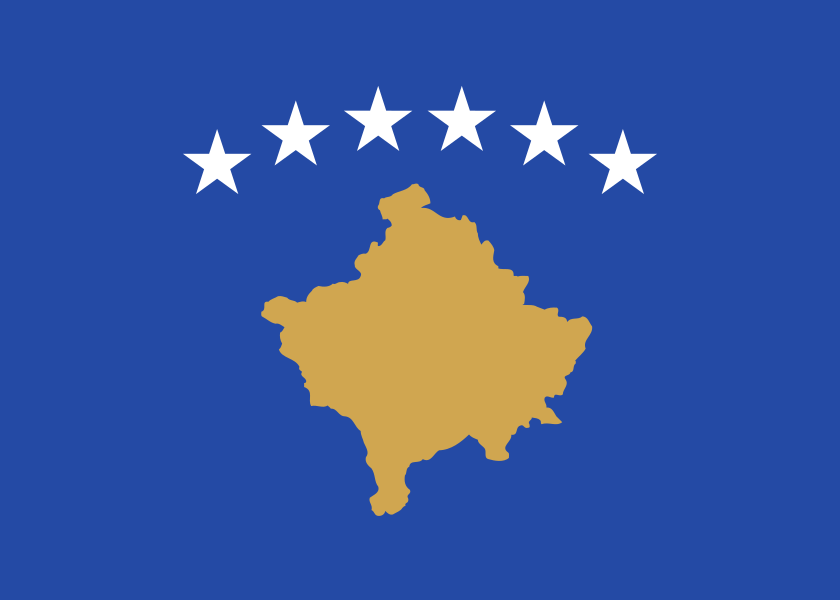
Kosovo
Kosovo is young, mountainous, and easy to combine with Albania, North Macedonia, or Montenegro. Pristina brings cafe culture and contemporary history, while Prizren, Rugova Canyon, and Ottoman bridges give the trip depth.

Latvia
Latvia balances Riga's Art Nouveau streets, Baltic beaches at Jurmala, Gauja National Park castles, and a strong song and folk tradition. It is a practical first Baltic trip, especially by train or bus from Estonia or Lithuania.