Why visit
Slovakia is a mountain-and-castle country: Bratislava on the Danube, High Tatras trails, Spiš Castle, limestone caves, and wooden churches in the northeast. It gives a lighter, easier alternative to bigger Central European itineraries.
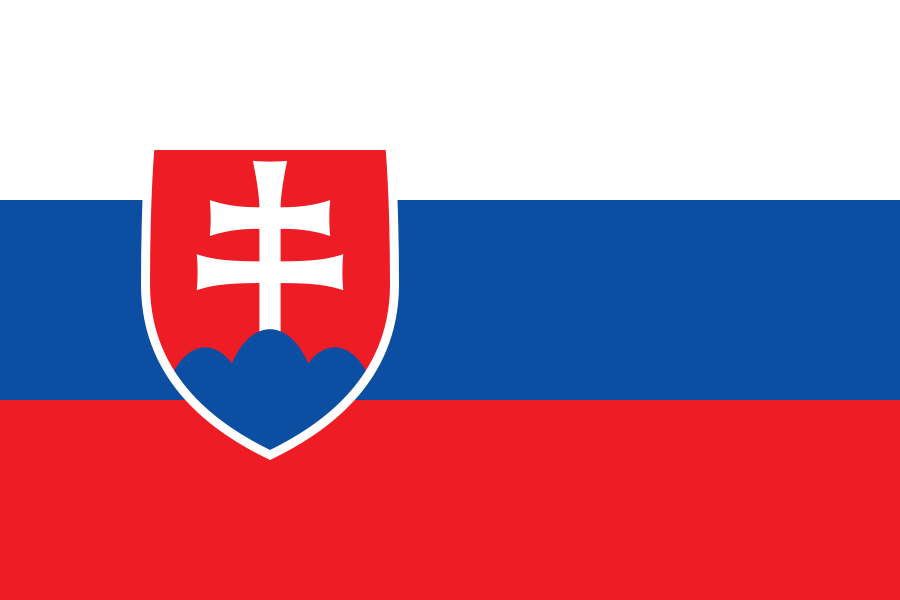
Country - Europe
Why visit
Slovakia is a mountain-and-castle country: Bratislava on the Danube, High Tatras trails, Spiš Castle, limestone caves, and wooden churches in the northeast. It gives a lighter, easier alternative to bigger Central European itineraries.
How to use this result
Slovakia works best as a first-pass travel idea. Start with the region, season, and themes on this page, then compare flights, entry rules, safety guidance, and local transport before treating it as a real option.
Use Bratislava as the administrative starting point, then check whether the strongest trip idea is actually the capital, a coastal area, a nature route, or another city in Slovakia.
At a glance
Location
48.7°, 19.5°
Coast
Landlocked
Traffic
Drives on the right
Time zones
Single time zone
Country area
49,037 km²
18,933 mi²
Country population
5.4 million
111/km²
Subregion
Central Europe
Currency
Euro (€)
EUR
Dial
+421
Language
Slovak
Demonym
Slovak
Internet
.sk
UN
Member state
ISO code
SK / SVK
Where in the world
48.7° - 19.5°
Click the map to open in Google Maps. Outline via svg-maps/world - CC BY 4.0
Did you know
Bordering Slovakia
Traveler notes
Plan checks
Explore more
Facts last reviewed June 2026 against GeoNames and national statistics sources. See the editorial policy for how destination data is maintained.
Frequently asked about Slovakia
Bratislava is the capital of Slovakia.
Slovakia uses the Euro (€), ISO code EUR.
The primary language is Slovak.
Yes, Slovakia is landlocked: it has no sea coastline.
Slovakia borders Austria, Czechia, Hungary, Poland, Ukraine.
The calling code is +421.
May–Oct, Dec–Mar for skiing. Check current weather and local events before booking.
Other Europe destinations

San Sebastián
San Sebastián has more Michelin stars per capita than any city on earth, a crescent of sand at La Concha, and pintxos bars that are closer to an Olympic sport than dining.

Florence
Florence is the Renaissance in a walled walking city. Uffizi, Duomo, Ponte Vecchio, Accademia (David). Plus Tuscan day-trips to Siena and San Gimignano.
Venice
Venice is 118 islands, 400 bridges, and a fragile lagoon you can cross by vaporetto. Visit in shoulder season; the crush of high summer hurts everyone.
Milan
Milan is Italy's design and finance capital. The Last Supper, the Duomo's roof terraces, Brera's gallery and aperitivo, and the Navigli canals at night.
Naples
Naples is pizza's birthplace, the gateway to Pompeii, and the wildest, most alive city in Italy. Spaccanapoli's alleys, Capodimonte's art, and the Amalfi Coast next door.

Munich
Munich is Bavarian capital. Marienplatz, Viktualienmarkt, English Garden (larger than Central Park), Oktoberfest, and BMW Welt. Alpine day-trips to Neuschwanstein or Zugspitze.




