Why visit
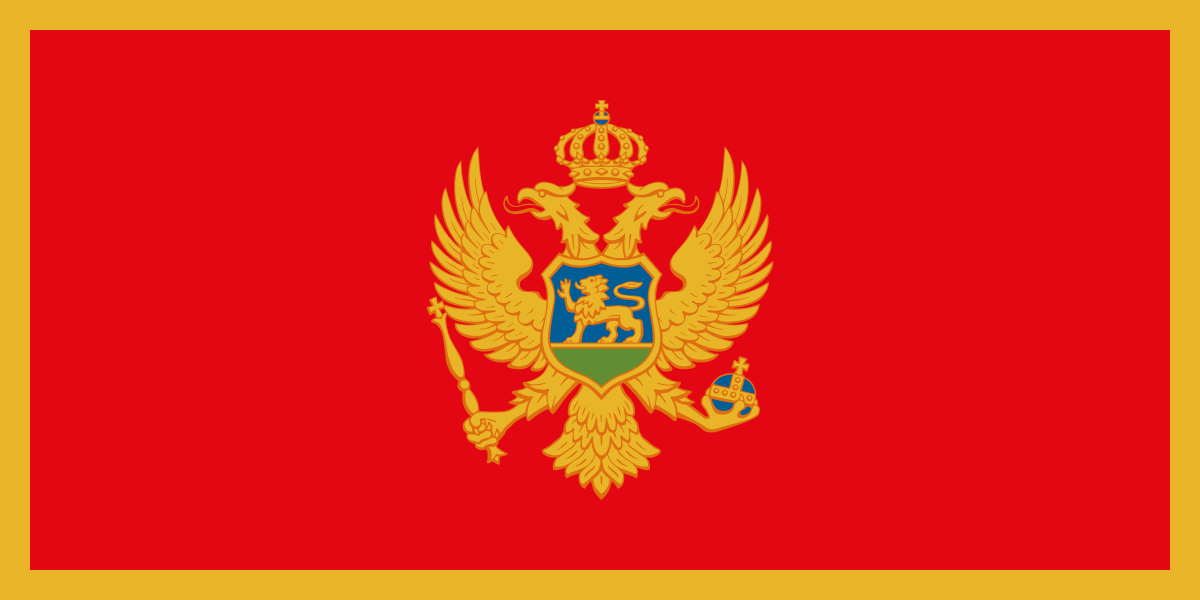
Podgorica is Montenegro's inland capital, more practical than postcard-pretty, but useful for rail, road, cafes, and trips to Lake Skadar, Cetinje, and the coast.
Why visit
Podgorica is Montenegro's inland capital, more practical than postcard-pretty, but useful for rail, road, cafes, and trips to Lake Skadar, Cetinje, and the coast.
How to use this result
Podgorica is useful when you want a city-level starting point in Montenegro. Check whether the capital is the best arrival city, a practical transfer point, or mainly a geography and planning reference.
Before planning around Podgorica, compare airport access, local transport, time zone, neighborhood choices, weather, safety guidance, and whether another city in Montenegro better matches the trip style.
Podgorica at a glance
City population
180k
Elevation
44 m
144 ft
Time zone
UTC+1 (UTC+2 DST)
Europe/Podgorica
Airport
TGD
Podgorica Airport (Golubovci)
Founded
1326 (first mention)
Getting around
Buses only; small walkable center
Signature dish
Kačamak, japraci, carp from Lake Skadar
Neighborhoods for travelers
Montenegro at a glance
Country center
42.5°, 19.3°
Coast
Has coastline
Traffic
Drives on the right
Time zones
Single time zone
Country area
13,812 km²
5,333 mi²
Country population
620k
45/km²
Subregion
Southeast Europe
Currency
Euro (€)
EUR
Dial
+382
Language
Montenegrin
Demonym
Montenegrin
Internet
.me
UN
Member state
ISO code
ME / MNE
Where in the world
42.5° - 19.3°
Click the map to open in Google Maps. Outline via svg-maps/world - CC BY 4.0
Did you know
Bordering Montenegro
Traveler notes
Plan checks
Explore more
Facts last reviewed June 2026 against GeoNames and national statistics sources. See the editorial policy for how destination data is maintained.
Frequently asked about Podgorica
Podgorica is the capital city of Montenegro. It has a population of about 180k. The city sits at 44 m above sea level.
Podgorica uses the Euro (€), ISO code EUR.
The primary language is Montenegrin.
The calling code is +382.
Apr–Jun, Sep–Oct. Check current weather and local events before booking.
Podgorica Airport (Golubovci) (IATA: TGD).
Other Europe destinations

Akureyri
Akureyri is Iceland's northern hub at the head of Eyjafjörður fjord. The base for Lake Mývatn geothermal fields, Goðafoss waterfall, and some of Europe's most reliable whale watching from nearby Húsavík.

Tallinn
Tallinn has a UNESCO medieval Old Town. 14th-century walls, Toompea Castle, Alexander Nevsky Cathedral. And a surprisingly hip Telliskivi Creative City.

Riga
Riga has the world's largest concentration of Art Nouveau architecture, a UNESCO old town, Central Market in old Zeppelin hangars, and Jūrmala beaches nearby.

Vilnius
Vilnius is Baltic baroque. Gates of Dawn, Vilnius Cathedral, the Republic of Užupis (a self-declared artists' micro-state), and Trakai's lake castle nearby.
Albania
Albania is Europe's last affordable coast. Riviera beaches at Ksamil, Ottoman Berat and Gjirokastër, the Albanian Alps for hiking, and Tirana's growing food scene.
Andorra
Andorra is a small Pyrenean country built around mountain roads, ski resorts, Romanesque churches, and thermal baths. It works best as a high-altitude stop between France and Spain, with easy access to Grandvalira, Ordino, and Andorra la Vella.