Why visit
Croatia is Dubrovnik's walls, Split's Diocletian Palace, Plitvice's waterfalls, Hvar and Vis islands, and Istrian truffle country.

Country - Europe
Why visit
Croatia is Dubrovnik's walls, Split's Diocletian Palace, Plitvice's waterfalls, Hvar and Vis islands, and Istrian truffle country.
How to use this result
Croatia works best as a first-pass travel idea. Start with the region, season, and themes on this page, then compare flights, entry rules, safety guidance, and local transport before treating it as a real option.
Use Zagreb as the administrative starting point, then check whether the strongest trip idea is actually the capital, a coastal area, a nature route, or another city in Croatia.
At a glance
Location
45.2°, 15.5°
Coast
Has coastline
Traffic
Drives on the right
Time zones
Single time zone
Country area
56,594 km²
21,851 mi²
Country population
3.9 million
68/km²
Subregion
Southeast Europe
Currency
Euro (€)
EUR
Dial
+385
Language
Croatian
Demonym
Croatian
Internet
.hr
UN
Member state
ISO code
HR / HRV
Where in the world
45.2° - 15.5°
Click the map to open in Google Maps. Outline via svg-maps/world - CC BY 4.0
Did you know
Bordering Croatia
Traveler notes
Plan checks
Signature travel cities in Croatia
Dubrovnik
Dubrovnik is a walled medieval city on the Adriatic. Stradun's polished limestone, city walls you can walk, and ferries to Lokrum and the Elaphiti islands.
Split
Split's Old Town is inside Diocletian's Palace. The Roman emperor's retirement home still occupied 1,700 years later. Ferry hub for the Dalmatian islands.
Explore more
Facts last reviewed June 2026 against GeoNames and national statistics sources. See the editorial policy for how destination data is maintained.
Frequently asked about Croatia
Zagreb is the capital of Croatia.
Croatia uses the Euro (€), ISO code EUR.
The primary language is Croatian.
No, Croatia has a coastline.
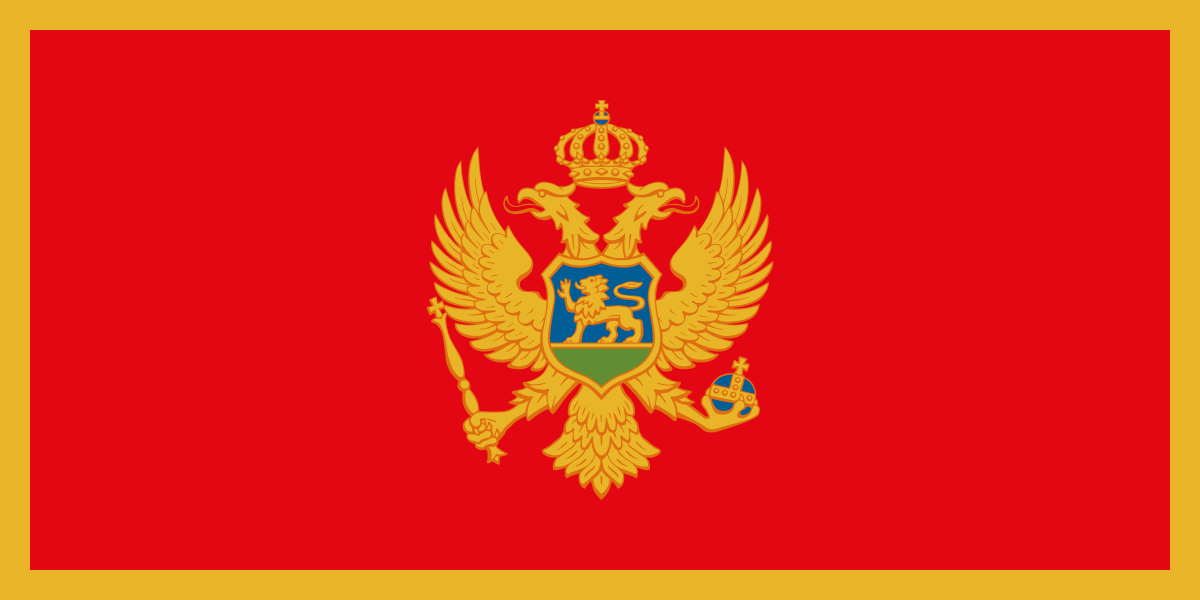
Croatia borders Bosnia & Herzegovina, Hungary, Montenegro, Serbia, Slovenia.
The calling code is +385.
May–Jun, Sep–Oct. Check current weather and local events before booking.
Other Europe destinations

Russia
Russia is vast: Moscow and St. Petersburg, the Golden Ring, the Trans-Siberian railway, Lake Baikal, Arctic north, and Caucasus mountains. Current access and travel conditions vary sharply, so treat planning as a separate step.
San Marino
San Marino is a hilltop microstate wrapped around Mount Titano, with medieval towers, steep lanes, and views across Emilia-Romagna to the Adriatic. It is easy to pair with Bologna, Rimini, or Ravenna.
Serbia
Serbia mixes Belgrade nightlife, Novi Sad and Petrovaradin Fortress, Orthodox monasteries, Danube gorges, and national parks such as Tara and Đerdap. It is strongest for travelers who like cities, music, food, and road trips.
Slovakia
Slovakia is a mountain-and-castle country: Bratislava on the Danube, High Tatras trails, Spiš Castle, limestone caves, and wooden churches in the northeast. It gives a lighter, easier alternative to bigger Central European itineraries.

Slovenia
Slovenia is Lake Bled, Ljubljana's car-free center, Postojna caves, the Soča Valley, and Alpine hiking at Triglav. Small enough to see end-to-end in a week.

Spain
Spain offers Madrid's museums, Barcelona's Modernisme, Seville's flamenco, San Sebastián's pintxos, Granada's Alhambra, and Balearic and Canary islands. Nights start late; dinner at 9pm.