Why visit
Cologne's Gothic cathedral is Germany's most visited landmark, the Rhine's busiest riverfront for beer gardens, and a carnival that rivals Rio's in intensity.

Why visit
Cologne's Gothic cathedral is Germany's most visited landmark, the Rhine's busiest riverfront for beer gardens, and a carnival that rivals Rio's in intensity.
Country
Region
Europe
How to use this result
Cologne is included because it has traveler appeal beyond being a dot on the map. Use the themes, neighborhoods, notes, and season guidance to decide whether it fits a weekend, longer route, or writing prompt.
For a real trip, check how Cologne connects with nearby cities, airports, rail or bus routes, local costs, weather, and entry rules for Germany.
Cologne at a glance
City population
1.1 million
Elevation
53 m
174 ft
Time zone
UTC+1 (UTC+2 DST)
Europe/Berlin
Airport
CGN
Cologne Bonn Airport
Founded
50 CE (Roman colony)
Getting around
Stadtbahn light rail, S-Bahn, buses
Signature dish
Himmel un Ääd, halver Hahn, Kölsch served in the brewery houses
Neighborhoods for travelers
Germany at a glance
Country center
51.0°, 9.0°
Coast
Has coastline
Traffic
Drives on the right
Time zones
Single time zone
Country area
357,114 km²
137,882 mi²
Country population
83.3 million
233/km²
Subregion
Western Europe
Currency
Euro (€)
EUR
Dial
+49
Language
German
Demonym
German
Internet
.de
UN
Member state
ISO code
DE / DEU
Where in the world
51.0° - 9.0°
Click the map to open in Google Maps. Outline via svg-maps/world - CC BY 4.0
Did you know
Bordering Germany
Traveler notes
Plan checks
Explore more
Facts last reviewed June 2026 against GeoNames and national statistics sources. See the editorial policy for how destination data is maintained.
Frequently asked about Cologne
Cologne is in Germany, in Europe.
Cologne uses the Euro (€), ISO code EUR.
The primary language is German.
The calling code is +49.
Cologne Bonn Airport (IATA: CGN).
Other Europe destinations

Akureyri
Akureyri is Iceland's northern hub at the head of Eyjafjörður fjord. The base for Lake Mývatn geothermal fields, Goðafoss waterfall, and some of Europe's most reliable whale watching from nearby Húsavík.

Tallinn
Tallinn has a UNESCO medieval Old Town. 14th-century walls, Toompea Castle, Alexander Nevsky Cathedral. And a surprisingly hip Telliskivi Creative City.

Riga
Riga has the world's largest concentration of Art Nouveau architecture, a UNESCO old town, Central Market in old Zeppelin hangars, and Jūrmala beaches nearby.

Vilnius
Vilnius is Baltic baroque. Gates of Dawn, Vilnius Cathedral, the Republic of Užupis (a self-declared artists' micro-state), and Trakai's lake castle nearby.
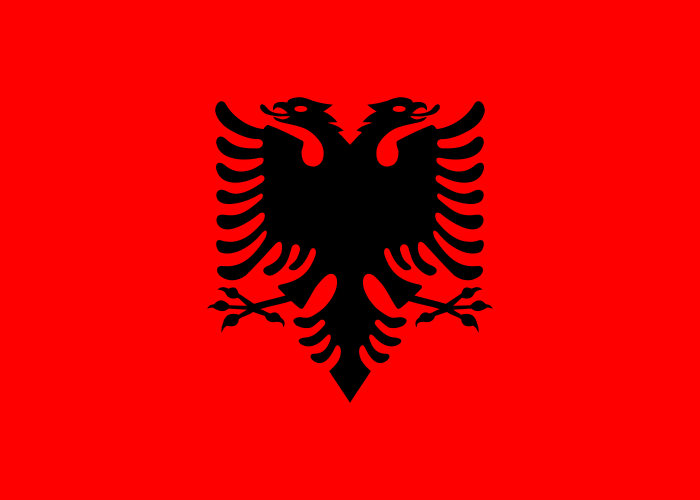
Albania
Albania is Europe's last affordable coast. Riviera beaches at Ksamil, Ottoman Berat and Gjirokastër, the Albanian Alps for hiking, and Tirana's growing food scene.
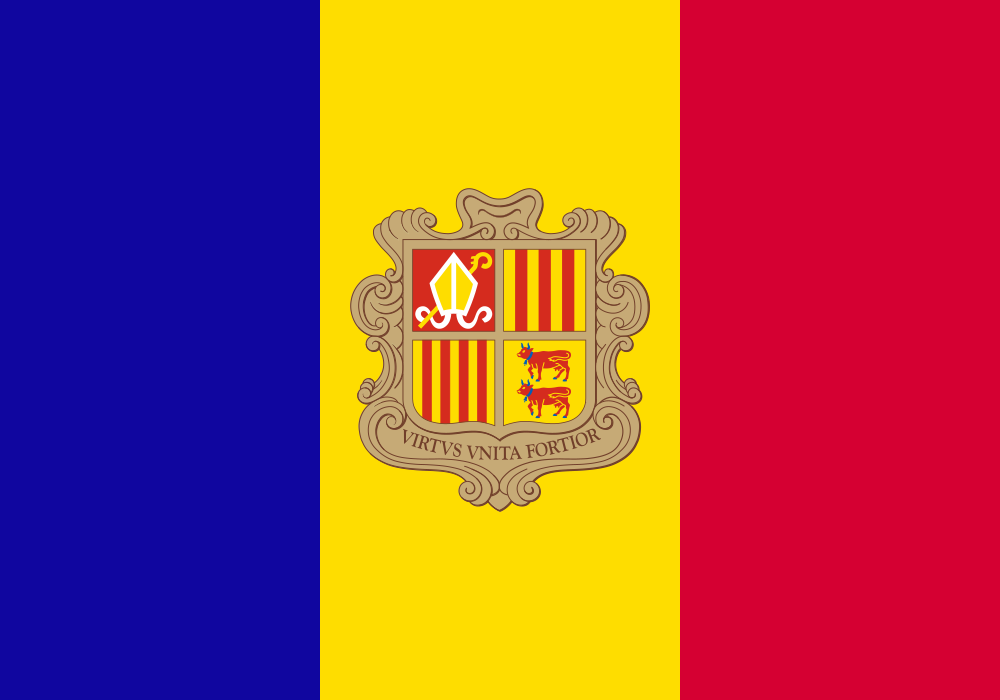
Andorra
Andorra is a small Pyrenean country built around mountain roads, ski resorts, Romanesque churches, and thermal baths. It works best as a high-altitude stop between France and Spain, with easy access to Grandvalira, Ordino, and Andorra la Vella.