Why visit
Malabo sits on Bioko island below Pico Basilé, with Spanish colonial buildings, black-sand beaches nearby, and rainforest rising quickly inland. It is one of Africa's more unusual island capitals.
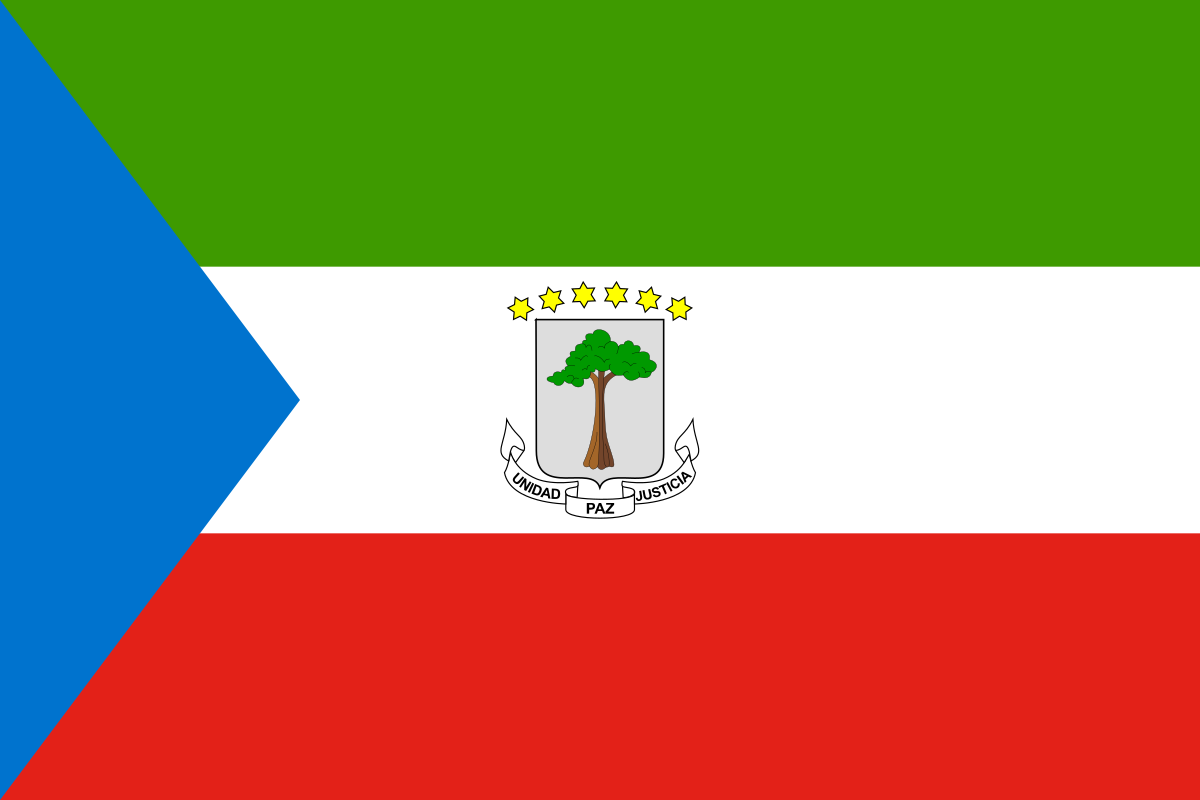
Why visit
Malabo sits on Bioko island below Pico Basilé, with Spanish colonial buildings, black-sand beaches nearby, and rainforest rising quickly inland. It is one of Africa's more unusual island capitals.
How to use this result
Malabo is useful when you want a city-level starting point in Equatorial Guinea. Check whether the capital is the best arrival city, a practical transfer point, or mainly a geography and planning reference.
Before planning around Malabo, compare airport access, local transport, time zone, neighborhood choices, weather, safety guidance, and whether another city in Equatorial Guinea better matches the trip style.
Malabo at a glance
City population
156k
Elevation
34 m
112 ft
Time zone
UTC+1
Africa/Malabo
Airport
SSG
Malabo International Airport
Equatorial Guinea at a glance
Country center
2.0°, 10.0°
Coast
Has coastline
Traffic
Drives on the right
Time zones
Single time zone
Country area
28,051 km²
10,831 mi²
Subregion
Middle Africa
Currency
Central African CFA franc (Fr)
XAF
Dial
+240
Languages
French, Portuguese, Spanish
Demonym
Equatorial Guinean
Internet
.gq
UN
Member state
ISO code
GQ / GNQ
Where in the world
2.0° - 10.0°
Click the map to open in Google Maps. Outline via svg-maps/world - CC BY 4.0
Did you know
Bordering Equatorial Guinea
Traveler notes
Plan checks
Explore more
Facts last reviewed June 2026 against GeoNames and national statistics sources. See the editorial policy for how destination data is maintained.
Frequently asked about Malabo
Malabo is the capital city of Equatorial Guinea. It has a population of about 156k. The city sits at 34 m above sea level.
Malabo uses the Central African CFA franc (Fr), ISO code XAF.
The primary languages are French, Portuguese and Spanish.
The calling code is +240.
Dec–Feb. Check current weather and local events before booking.
Malabo International Airport (IATA: SSG).
Other Africa destinations

Ethiopia
Ethiopia is a rare destination where culture travel still feels like discovery. Rock-hewn churches at Lalibela, the Danakil Depression, the Simien mountains, and a food scene centered on injera and coffee ceremonies.
Gabon
Gabon keeps almost 90 percent of its land under forest and made 13 national parks in one stroke in 2002. Loango is the famous one: forest elephants and buffalo walking ocean beaches, plus surfing hippos in the right season.
Gambia
The Gambia is a river with a country around it, and West Africa's easiest first stop. Atlantic beach resorts near Banjul, river trips past Kunta Kinteh Island, and more than 500 recorded bird species in a country smaller than Connecticut.

Ghana
Ghana is West Africa's most accessible introduction: the slave forts of Cape Coast and Elmina, Kakum's canopy walkway, Ashanti culture around Kumasi, and Accra's music and food scene.
Guinea
Guinea is the source of the Niger River and home to the Fouta Djallon highlands, a green plateau of waterfalls and hiking trails between Fulani villages. Almost no mass tourism reaches it.
Guinea-Bissau
Guinea-Bissau's Bijagós Archipelago is the draw: 88 islands with saltwater hippos, nesting turtles, and matriarchal island cultures, protected as a UNESCO biosphere reserve.