Why visit
Port-au-Prince is Haiti's capital, a city of markets, art, music, hills, and difficult recent history. Travel conditions have been highly unstable, but the city remains central to Haitian culture.
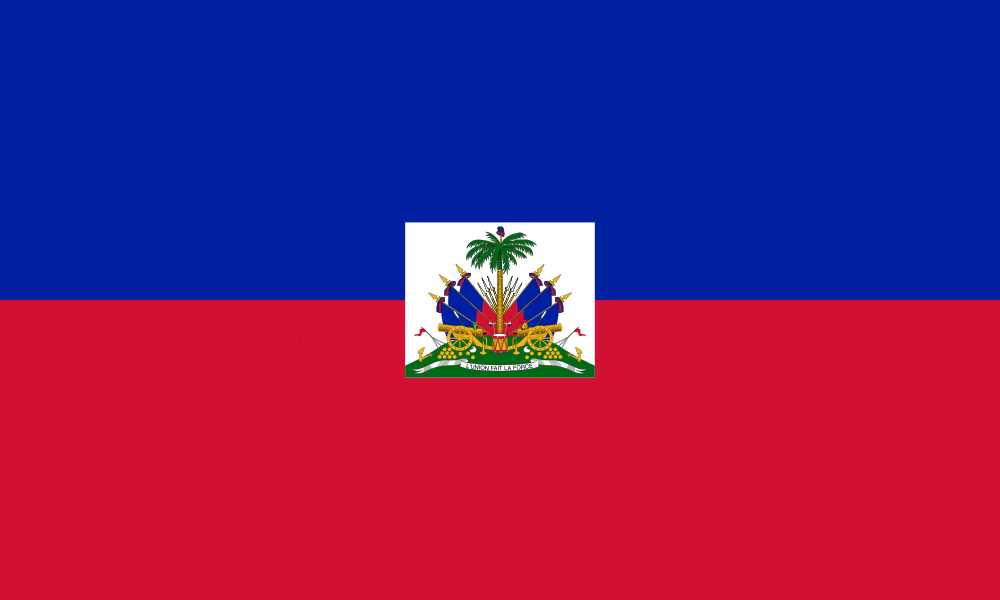
Why visit
Port-au-Prince is Haiti's capital, a city of markets, art, music, hills, and difficult recent history. Travel conditions have been highly unstable, but the city remains central to Haitian culture.
How to use this result
Port-au-Prince is useful when you want a city-level starting point in Haiti. Check whether the capital is the best arrival city, a practical transfer point, or mainly a geography and planning reference.
Before planning around Port-au-Prince, compare airport access, local transport, time zone, neighborhood choices, weather, safety guidance, and whether another city in Haiti better matches the trip style.
Port-au-Prince at a glance
City population
1.2 million
Elevation
27 m
89 ft
Time zone
UTC-5 (UTC-4 DST)
America/Port-au-Prince
Airport
PAP
Toussaint Louverture International Airport
Haiti at a glance
Country center
19.0°, -72.4°
Coast
Has coastline
Traffic
Drives on the right
Time zones
Single time zone
Country area
27,750 km²
10,714 mi²
Country population
11.6 million
417/km²
Subregion
Caribbean
Currency
Haitian gourde (G)
HTG
Dial
+509
Languages
French, Haitian Creole
Demonym
Haitian
Internet
.ht
UN
Member state
ISO code
HT / HTI
Where in the world
19.0° - -72.4°
Click the map to open in Google Maps. Outline via svg-maps/world - CC BY 4.0
Did you know
Bordering Haiti
Traveler notes
Plan checks
Explore more
Facts last reviewed June 2026 against GeoNames and national statistics sources. See the editorial policy for how destination data is maintained.
Frequently asked about Port-au-Prince
Port-au-Prince is the capital city of Haiti. It has a population of about 1.2 million. The city sits at 27 m above sea level.
Port-au-Prince uses the Haitian gourde (G), ISO code HTG.
The primary languages are French and Haitian Creole.
The calling code is +509.
Dec–Mar. Check current weather and local events before booking.
Toussaint Louverture International Airport (IATA: PAP).
Other North America destinations

Mérida
Mérida is the cultural capital of the Yucatán. Grand colonial plazas, cenote haciendas, Chichén Itzá and Uxmal within day-trip distance, and Maya-Yucatec cuisine.

Boston
Boston walks American history along the 4 km Freedom Trail, from Boston Common to Bunker Hill, then feeds you in the Italian North End. Harvard and MIT sit across the Charles River in Cambridge.
Antigua Guatemala
Antigua is a UNESCO colonial town with Volcán de Agua and Fuego on the skyline. Spanish language schools, coffee tours, and Acatenango's two-day volcano climb.
Antigua & Barbuda
Antigua and Barbuda is a two-island Caribbean country built around sailing, reef beaches, and maritime history. Antigua has the harbors and resort base, while Barbuda adds pink-sand beaches and one of the region's great frigatebird colonies.
Bahamas
The Bahamas is an Atlantic archipelago of clear-water cays, blue holes, reef walls, and easy island-hopping from Florida. Nassau is the gateway, but the Exumas, Eleuthera, Andros, and Abacos shape the best slower trips.
Barbados
Barbados blends Bridgetown history, Atlantic surf at Bathsheba, calm west-coast beaches, rum distilleries, and a strong food culture. It is one of the Caribbean's easiest islands for independent exploration.